

 Salesforce is becoming AI's favorite hiring pool Salesforce is becoming AI's favorite hiring pool
| FULL STORY |
|
Meta's morale is the worst it's been since Cambridge Analytica
| FULL STORY |
|
Europe blinked on its own AI law
| FULL STORY |
What else happened today?What AI tools should I be using?Good Morning Thorium Valley. OpenAI and Anthropic have quietly pulled about 100 people out of Salesforce in six months. Almost all salespeople. When you're selling AI to the same CIOs Salesforce has called on for twenty years, why build a sales org when you can just take theirs.
Over at Meta, the CTO told employees morale is the worst since Cambridge Analytica. Engineers shoved into AI training work are calling it "the gulag." Zuckerberg sent a memo admitting mistakes. That should do it.
And Europe spent three years writing the world's strictest AI law, then gutted the hardest parts before they ever took effect. Funny what happens when Anthropic pulls its models out of your continent.

ENTERPRISE
Over the past six months, roughly 100 Salesforce employees have quietly left for OpenAI or Anthropic. Almost all of them worked in sales.
The numbers, first reported by The Information, break down to about 60 heading to OpenAI and 40 to Anthropic, concentrated in go-to-market roles. The reason is simple: frontier labs aren't just frontier labs anymore — they're enterprise software companies selling to the same CIOs Salesforce has called on for twenty years. OpenAI alone says it now has more than a million business customers. To keep that going, you need people who know how to close seven-figure deals, and Salesforce has more of those people than anywhere else.
The clearest signal came last week, when OpenAI named Denise Dresser as its new Chief Revenue Officer. Dresser ran Slack and spent years inside Salesforce. Now she's building the sales org that will push ChatGPT into the enterprise — a hire that says everything about where OpenAI thinks its next phase of growth lives.
Salesforce isn't pretending nothing is happening. The company recently laid out a plan that leans into what AI can and can't do:
+ Growing sales headcount by 20% this year while hiring zero new engineers
+ Tripling its "forward deployed engineer" team in six months — a hybrid sales-consulting-technical role borrowed from Palantir
+ Leaning on its own AI agents to handle internal work: its Agentforce product now resolves 63% of customer support questions autonomously and has booked hundreds of meetings off cold prospects with no human involved
The logic is clear. Agents can handle a lot of the internal grind. What they still can't do is sit across the table from a procurement officer and convince them to switch CRMs. So the headcount shifts toward humans who can.
There's an awkward layer here worth noting: Salesforce is reportedly planning to spend around $300 million on Anthropic's tokens next year — even as Anthropic keeps hiring its salespeople. Benioff himself recently called Anthropic's coding agents "awesome." It's the kind of relationship where you write the check, then watch your top reps walk across the street to the company you're paying.

The interesting part isn't the poaching itself, it's what it says about where AI companies think the next phase of growth actually lives. Frontier labs spent three years competing on benchmarks. They're now competing on quota. The thing that decides who wins enterprise AI in 2026 isn't whose model scores higher on an eval. It's whose sales team can close Q3, and right now both OpenAI and Anthropic seem to have decided the fastest way to build one is to take Salesforce's.

BIG TECH
Meta's CTO told employees this month that morale is near the lowest he's seen in 20 years at the company. The last time it felt this bad? Cambridge Analytica.
Andrew Bosworth made the comparison during an internal Q&A session, first reported by Business Insider. The reason isn't hard to find. Over the past few months, Meta has reshaped roughly one in five roles across the company:
+ ~8,000 layoffs earlier this year, about 10% of the workforce, plus 6,000 open roles closed
+ ~7,000 employees moved into AI work, many involuntarily, pulled off consumer products like Instagram and WhatsApp
The pain is concentrated in Meta's new Applied AI unit, a roughly 6,500-person group led by Reality Labs veteran Maher Saba. Engineers inside it told Business Insider and TechCrunch the work feels like "the gulag" — data labeling, evaluation tasks, and coding puzzles to train Meta's models. People who joined to build consumer products are now grinding through AI training data.
Zuckerberg eventually sent a memo admitting the company had made mistakes and promising no more mass layoffs for the rest of the year. Bosworth conceded that leadership had done "an atrocious job explaining the vision." That's a Meta executive saying out loud what leaked internal screenshots already implied.
The bigger pattern is hard to miss. The same dynamic hitting junior coders and offshore labor over the past year is now showing up inside one of the companies actually building the models.
Meta's business is still excellent. Revenue is up 33% year over year and ad pricing keeps climbing, so the company will probably tell itself that morale is the cost of doing business in the AI era and the numbers prove the strategy works. The trouble with that logic is that the people you need most in an AI race are the ones with the most options to leave. Zuckerberg can afford to lose engineers who hate Applied AI. He probably cannot afford the next round of star researchers deciding that the gulag jokes were actually warnings.
GOVERNANCE
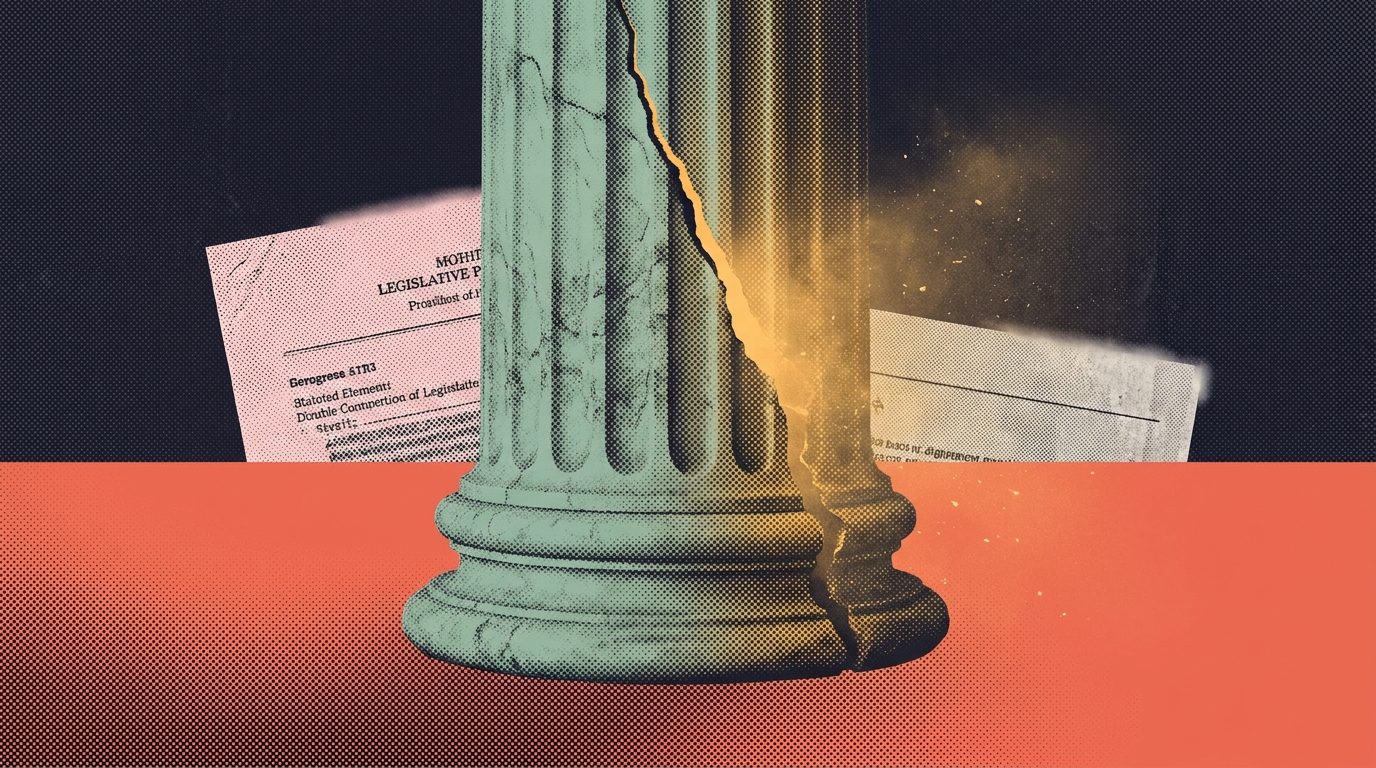
Europe spent three years writing the world's strictest AI law. It just spent a few months walking it back.
On Nov. 13, the European Parliament voted 423-57 to approve the AI Act Omnibus, a package that delays the heaviest parts of the AI Act before they ever took effect. The high-risk rules covering AI in hiring, education, credit scoring, biometrics and policing — originally due Aug. 2, 2026 — are now pushed to December 2027. Rules for AI in regulated products like medical devices slip to August 2028.
The official reason: the harmonized technical standards companies need to prove compliance aren't finished. The unofficial reason is Anthropic. When the company pulled its models out of Europe in June over US export rules, it set off a sovereignty panic and handed every "Europe is falling behind" argument a fresh data point. Within weeks, the case for going easier on European AI companies basically wrote itself.
What changed in the law:
+ High-risk rules delayed: Annex III systems (hiring, credit, policing, education) pushed from August 2026 to December 2027. Annex I systems (regulated products) pushed to August 2028.
+ Industrial carve-out: A new exemption for AI in industrial machinery and certain regulated products — the only piece almost everyone agrees is a real substantive cut.
+ Registration weakened: The public database for high-risk AI systems gets narrowed.
+ Transparency softened: Several disclosure obligations for general-purpose models get loosened.
The people who built this law aren't thrilled. Gabriele Mazzini, the lead author of the AI Act and now a research affiliate at MIT, said the EU's model has "grown too complex, too broad and too rigid and bureaucratic to adjust." That's the architect saying the thing doesn't work.
Underneath all of this is a fight over who really pushed for the delay. Critics in Brussels argue the "AI Act kills innovation" narrative has been driven largely by American hyperscalers, and that Europe's AI gap is really about capital and market access, not regulation. Civil society groups including EDRi, Access Now and Amnesty International called the Omnibus a rollback that "weakens the AI Act, emboldens industry lobbying, and undermines the EU's credibility as a serious digital regulator." Their point: the things being delayed are the things meant to protect people from AI used on them, not the things that make life hard for engineers.
For a decade, Europe's whole pitch was that it would regulate what America wouldn't, and the rest of the world would follow. The Omnibus is the first real moment that pitch cracked, and it cracked not because the law was proven wrong but because one US company pulled its models and everyone in Brussels suddenly remembered they don't have a frontier lab of their own. The next two years won't be about whether Europe enforces the AI Act. They'll be about whether anyone outside Europe still thinks the AI Act is the template to copy.
IN OTHER NEWS
+ SpaceX is buying Cursor for $60 billion in stock, days after its blockbuster IPO
+ G7 leaders warn the U.S. that American AI needs a guarantee it won't be switched off overnight
+ Taiwan busts an Nvidia chip smuggling ring rerouting AI servers to China through fake export paperwork
+ Salesforce acquires AI customer service platform Fin (formerly Intercom) for $3.6 billion
+ xAI's trade-secrets lawsuit against OpenAI has been thrown out by a judge
+ Facebook's new AI Mode mines every public post with no opt-out for 2 billion users
+ World model startup Odyssey hits unicorn status with $310M raise backed by Amazon, AMD, and Google
+ Huawei's chairman publicly thanked U.S. sanctions for forcing China to build a chip stack that now competes with Nvidia
WHO'S HIRING IN AI
AI OR REAL?

Option A |

Option B |



AI TOOLS
+ Microsoft Copilot Cowork: Now generally available, Cowork is an AI teammate inside Microsoft 365 that handles complex, multi-step tasks across your docs, emails, and apps — even while your laptop is closed
+ Google Vids: AI avatars and video creation are now free for all Google accounts — turn any Slides deck into a narrated video with a digital presenter in minutes
+ Adobe Firefly Graph: A new node-based tool in Creative Cloud that lets you chain AI steps together — generate an image, remove the background, upscale it — into reusable, repeatable workflows
+ Midjourney: V8.1 now has a Draft Mode that generates 24 images at once for half the compute cost, so you can browse options fast and only render the ones you love
+ Google Home Speaker: Google's $99 smart speaker is the first device built for Gemini — it understands natural speech, handles multiple commands at once, and lets you correct yourself mid-sentence
That's all for today. If this issue made you think, share it with someone who needs to think harder.
Written by Jason Chen, Advait Prakash, Andrew Hales, and the Thorium Valley crew.
That's all for today's Thorium Valley. See you tomorrow.