
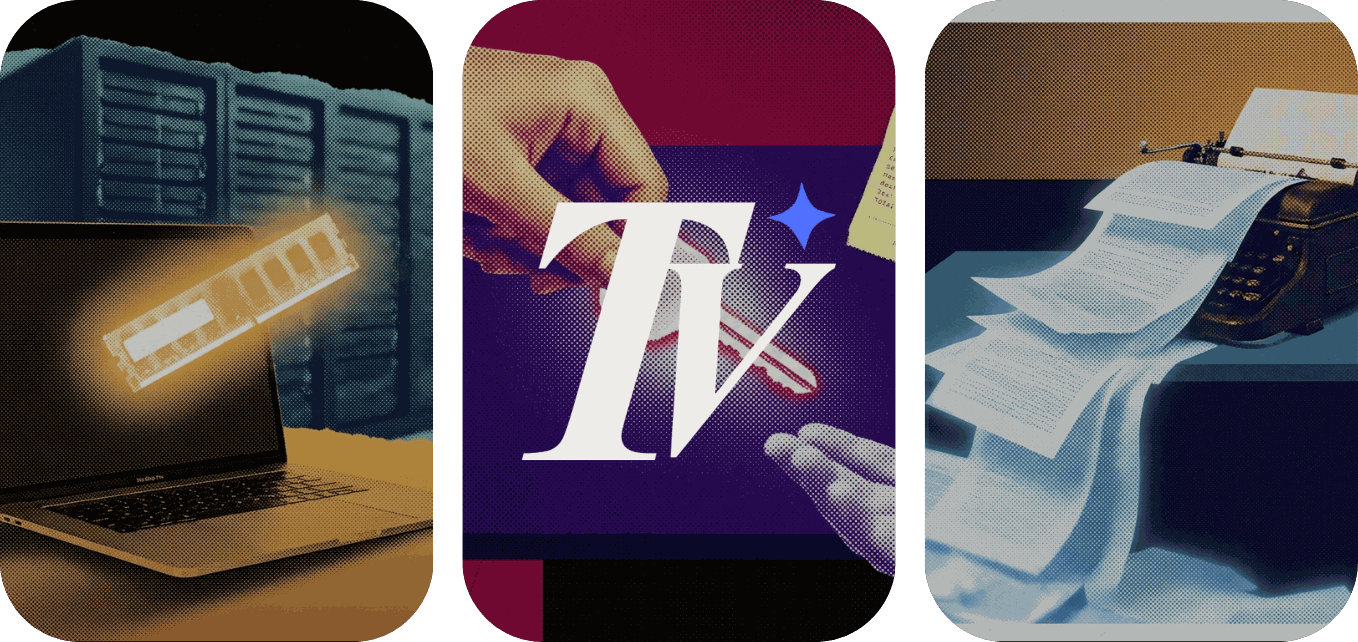

 Meta makes a cheaper bet on smart glasses Meta makes a cheaper bet on smart glasses
| FULL STORY |
|
OpenAI built itself a chip
| FULL STORY |
|
Your engineers aren't the ones burning the AI budget
| FULL STORY |
What else happened today?What AI tools should I be using?Good Morning Thorium Valley. Meta put AI glasses at $299, trying to own the category before Google shows up with hardware. Ninety percent of bystanders say they'd take defensive action if someone's glasses were recording them. Meta thinks that'll work itself out. Sure.
OpenAI named its first custom chip Jalapeño. It's the latest company to look at Nvidia's 70% margins and go, yeah, we'd like to keep that.
And the people blowing through corporate AI budgets? Not engineers. Everyone else. Uber gamified AI usage, burned a full year's budget in four months, and now the industry needs an entire foundation just to figure out what companies are even spending.

CONSUMER
Meta wants smart glasses on every face, and it just dropped the price to get there.
On Tuesday, Meta unveiled a new line of AI smart glasses starting at $299 — the cheapest entry point yet for a category Meta has spent three years trying to define. The new line is sold under the Meta Glasses name, separate from the Ray-Ban and Oakley collaborations that have done the heavy lifting so far.
What to know about the launch:
+ The price: $299 for the base model, well below the $379 starting point on Ray-Ban Meta
+ A new AI brain: The glasses run Muse Spark, Meta's purpose-built on-device model that replaces Llama 4, with frontier-level reasoning built into a pair of glasses
+ The play: Meta is flooding price points before Google can show up with hardware — and Google's Gemini ecosystem, already embedded in billions of people's email, photos, and search, makes it a serious threat
The price cut is the real story. At the press event, CTO Andrew Bosworth said Meta needs to reach people across design, style, and price. The company already has the $379 Ray-Ban customer. Now it's going after the one who won't pay that. That second customer might be the bigger market — EssilorLuxottica said it sold more than 7 million smart glasses units last year, roughly triple the prior year.
The harder problem is the person standing next to you. A recent study of wearers and bystanders found that up to 90% of bystanders said they'd take defensive action if they realized smart glasses were recording them. Bosworth's answer is patience — he told reporters that cameras on faces will go the way of cameras in pockets, and people will stop noticing.
At $299, that bet becomes plausible. If 7 million units in 2025 turns into something like 20 million in 2026, the privacy conversation doesn't get resolved — it gets steamrolled. Bosworth is probably right that this is a social learning moment. He's just being polite about who's doing the learning.

PRODUCTS
OpenAI is now in the chip business.
On Wednesday, OpenAI and Broadcom unveiled Jalapeño, a custom chip optimized for LLM inference — meaning it handles the part where ChatGPT actually answers your question, not the part where the model gets trained. The first units are expected to roll out next year as part of what Broadcom is calling a multi-generation roadmap.
The chip was designed from the ground up around how OpenAI's own software actually behaves, optimizing for its specific memory and communication patterns. Broadcom CEO Hock Tan framed it as "a fundamental commitment to scaling the physical infrastructure required for the next decade of AI." OpenAI's Greg Brockman, meanwhile, said Jalapeño is part of a broader plan to make compute "more abundant" — the company's way of telling investors it's serious about owning more of its own infrastructure.
The reason this matters comes down to one company that wasn't in the announcement: Nvidia. Nvidia sells the picks and shovels of the entire AI boom and runs gross margins around 70%. For every company writing checks to Nvidia, that 70% is money walking out the door. Jeff Bezos has a famous line for moments like this: Your margin is my opportunity.
That's the logic behind every custom AI chip on the market right now. Google has TPUs. Amazon has Trainium. Meta is working with Broadcom on its own silicon, with Zuckerberg recently calling the partnership central to Meta's computing foundation. OpenAI joining the club isn't surprising — it's confirmation of where the whole industry is headed. If you own the chip, you control the cost curve, the supply chain, and the design choices that matter most for your models.
The tradeoff is that a chip this specialized only stays valuable as long as AI architectures don't shift too dramatically. Nvidia's GPUs stay dominant in part because they're flexible enough to run almost anything, backed by CUDA, the software layer every AI developer already knows. Jalapeño is a bet that OpenAI knows exactly what its workloads will look like for years to come.

For OpenAI, that bet looks reasonable. The company knows its own models and serving patterns better than anyone, and it's currently writing some of the largest checks Nvidia has ever cashed. Building Jalapeño doesn't mean OpenAI is walking away from Nvidia, since Nvidia is still the best general-purpose AI chip company by a wide margin and OpenAI will keep buying their chips for years. But it does mean OpenAI now has a way to start chipping at that 70% margin. The real test isn't whether the first generation of Jalapeño performs well in 2026. It's whether the second and third generations close the gap on Nvidia fast enough that OpenAI can use the chip as leverage every time Jensen Huang quotes a new price.

ENTERPRISE
Companies are blowing through their AI spend faster than anyone planned for, and the people doing the damage aren't who you'd expect.
Leaked internal audio from an Accenture meeting, reported by 404 Media, revealed that the engineers everyone assumed were running up the meter actually aren't. It's everyone else. The non-engineers were given a chatbot and told to be productive. They are — enthusiastically — and the bills are showing it.
Uber is the clearest example. The company encouraged employees to use AI "as much as possible," gamified it with internal leaderboards, and then watched its annual AI budget evaporate in four months. The fix was a $1,500 monthly cap per employee, per agentic coding tool. As Simon Willison pointed out, if an engineer actively used two of those tools, the cap would run them $36,000 a year — roughly 11% of median engineer pay there.
The problem has gotten serious enough that the industry is building infrastructure around it. On Tuesday, the Linux Foundation announced the Tokenomics Foundation, a new group to establish open standards for AI cost management. Founding supporters include Accenture, JPMorganChase, Salesforce, Microsoft, and Google Cloud. The core problem:
+ Global token usage is projected to multiply 24x by 2030
+ Nobody has a shared way to even track what they're spending
+ Pricing structures — input vs. output tokens, cached vs. non-cached — change between providers, making it hard for even sophisticated buyers to know what they're actually paying for
A few months ago, AI spend was a CTO concern. Now it's a line item CEOs and CFOs are getting asked about on earnings calls. Token costs have quietly become a board-level issue, not an engineering footnote.
The interesting thing about Kwak's leaked quote isn't that non-engineers are using AI more than expected. It's that flat-rate software pricing trained an entire generation of office workers to believe their tools were free. They're about to learn they aren't. Expect the next year of enterprise AI to look less like a productivity revolution and more like a slow, awkward conversation about who gets the unlimited plan and who gets the $1,500 cap. The companies that figure out how to budget tokens like they budget headcount will quietly pull ahead. Everyone else is going to keep finding out, four months at a time, that the meter was always running.
IN OTHER NEWS
+ Anthropic's Mythos model broke into classified U.S. government systems in hours , not weeks, during a Pentagon testing exercise
+ Banned Nvidia chips are selling for double their price on China's black market as export controls fail to stop demand
+ Agility Robotics is going public at a $2.5 billion valuation , becoming the first pure-play humanoid robot company on Wall Street
+ A legal tech startup is suing the U.S. government for taking away access to Anthropic's Fable 5 model
+ Meta paused its AI keystroke tracking program after it accidentally exposed employees' private messages company-wide
+ Claude Fable 5 wrote a bootable Windows kernel in Rust in 38 minutes from an empty directory
+ A Google engineer says he was fired for building a Workspace CLI that went viral before anyone could decide what to do with it
+ A Munich court held Google directly liable for false information its AI Overviews invented, in a first-of-its-kind ruling
WHO'S HIRING IN AI
+ Pinterest — Staff Product Manager, AI Safety
+ Walt Disney Animation Studios — Production Innovation Technologist
+ Google — Product Manager, Advanced Enterprise Data Platform
+ Cisco — Principal Product Manager, AI Products

AI OR REAL?

Option A |

Option B |




AI TOOLS
+ Claude Tag: Anthropic's new Slack integration turns Claude into a persistent AI teammate that remembers your team's projects, works on tasks while you're offline, and can even jump into conversations on its own
+ GitHub Copilot CLI: The redesigned terminal interface is now generally available with tabbed navigation for browsing issues, pull requests, and gists without leaving your terminal
+ Seedance 2.5: ByteDance's new AI video model generates 30-second continuous clips at native 4K resolution — double what any competitor offers — with support for up to 50 reference inputs
+ YouTube: Creators can now replace copyright-flagged music in their videos with AI-generated royalty-free tracks, keeping their uploads and watch history intact
+ Cursor: Coinbase published a case study showing 2,400 engineers using the AI coding tool, with some teams cutting time from idea to production by 90% and 75% of all pull requests now created by agents
That's all for today. If this issue made you think, share it with someone who needs to think harder.
Written by Jason Chen, Advait Prakash, Andrew Hales, and the Thorium Valley crew.
That's all for today's Thorium Valley. See you tomorrow.