


 Bezos bets $10 billion on physical AI Bezos bets $10 billion on physical AI
| FULL STORY |
|
OpenAI's $2 billion a month still isn't enough
| FULL STORY |
|
The math behind why AI agents keep failing
| FULL STORY |
What else happened today?What AI tools should I be using?Good Morning Thorium Valley. Bezos is raising $10 billion for a physical AI lab at a $38 billion valuation. No revenue yet. Figure AI, which actually builds and ships humanoid robots, just raised at roughly the same number. Either the robots are undervalued or the pitch deck is overvalued.
OpenAI brings in $2 billion a month in revenue. It's still not close to breaking even. Some of its own investors are hedging by writing bigger checks to Anthropic. Lot of big numbers flying around AI this week. The math behind them keeps getting shakier.
And there's a brutally simple reason AI agents keep failing — multiply 90% accuracy across ten steps and you land at 35%. Most companies plan to deploy them within two years anyway. So that should go well.

MARKETS
The biggest AI raise of the year doesn't involve a chatbot.
Jeff Bezos' venture, Project Prometheus, is close to raising $10 billion at a $38 billion valuation, with BlackRock and JPMorgan among the backers. The lab is focused on physical AI: building machines that can see, move and make decisions in the real world rather than generate text on a screen. Bezos, who built Amazon's logistics empire from scratch, is betting that AI's most valuable applications won't be digital.
The valuation is what jumps out. A few things worth comparing:
+ Figure AI, which actually builds and ships humanoid robots, recently closed over $1 billion in Series C funding at a nearly identical $39 billion valuation — and it already has a production line capable of building up to 12,000 robots a year. Prometheus raised far more and doesn't appear to have revenue yet.
+ Bezos is hedging. Through Bezos Expeditions, he also invested in Skild AI, a robotics company that raised $1.4 billion and already has about $30 million in revenue across security, construction and warehouse deployments. Fund the moonshot and the company already making money, then see which one takes off.
+ He's not alone. NVIDIA partnered with Siemens to build AI-driven manufacturing sites, with the first going live in Germany this year and companies like Foxconn and PepsiCo already evaluating the technology.
The skeptics have a case, though. Bessemer Venture Partners described the current moment in robotics as "the GPT-2.5 moment" — the demos look real but reliable deployment at scale hasn't arrived. And there are hard infrastructure constraints: more than 200 gigawatts of energy projects are stuck in U.S. interconnection queues, bottlenecking the very facilities this buildout depends on.

The most telling detail isn't the $10 billion, it's that a pre-revenue lab and a company with an actual robot factory are valued within a billion dollars of each other. Investors aren't pricing what physical AI can do today. They're pricing where they think it'll be in five years, and that kind of forward pricing has defined both tech's greatest wins and its worst flameouts. Bezos seems to know this, which is why he's not picking one winner. He's funding his own lab and backing competitors at the same time, so whichever version of physical AI wins, he has a stake in it.
MARKETS
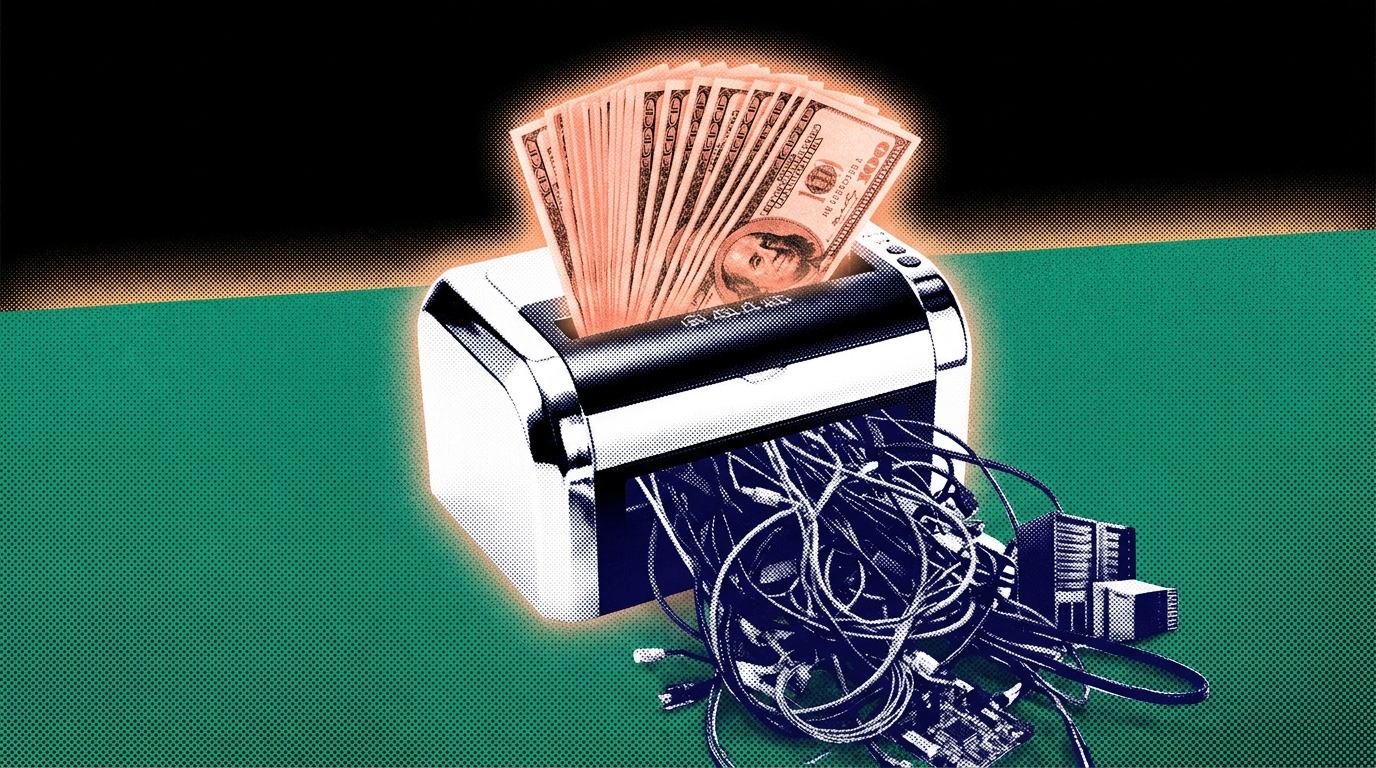
OpenAI brings in $2 billion a month in revenue. It's still not close to breaking even.
The company said enterprise now accounts for more than 40% of revenue. It recently closed $122 billion in funding at an $852 billion valuation — the largest private fundraise in history. By any normal startup measure, OpenAI is a juggernaut.
The spending tells a different story. Analysts project OpenAI's total infrastructure costs will hit roughly $792 billion through 2030, with a cumulative funding gap of around $207 billion even after expected revenue. Those costs come from deals that keep getting bigger — a recent $50 billion partnership with Amazon, layered on top of existing arrangements with Microsoft, Oracle, CoreWeave, and custom chip deals with NVIDIA and Broadcom. As Deutsche Bank analysts put it: "No startup in history has operated with losses on anything approaching this scale."
OpenAI's backers say the math works if you give it time — that partners will shoulder most data center costs, and projected compute capacity could eventually generate $140 billion a year. Not everyone is willing to wait. Some of OpenAI's own investors are hedging by writing larger checks to Anthropic. Iconiq Capital, which holds a smaller OpenAI stake, put over $1 billion into Anthropic. One partner told the Financial Times plainly: "There is fundamentally a number one and a number two dynamic, and the number one will win disproportionately. We picked."
It's easy to see why Anthropic is attractive by comparison:
+ It has reportedly turned down funding offers valuing it above $800 billion
+ It hasn't made anywhere near the same infrastructure commitments
+ It's growing enterprise revenue fast while running far leaner
The pressure is showing internally, too. OpenAI's CFO Sarah Friar has reportedly told colleagues she doesn't believe the company will be ready for an IPO in 2026, citing spending risks and organizational gaps. When investor Brad Gerstner pressed Altman on how a company generating $13 billion a year could commit to $1.4 trillion in total spending, Altman was blunt: "If you want to sell your shares, I'll find you a buyer. Enough."
Altman has said openly that the AI industry will see booms and busts. The problem is that $792 billion in infrastructure commitments don't pause for a bust. If revenue scales the way OpenAI projects, this goes down as the boldest bet in tech history. If it takes even a couple years longer than planned, the math starts to break. The investors quietly moving money toward Anthropic aren't betting against OpenAI so much as betting that the company willing to spend less might be the one still standing when the correction Altman himself is predicting finally shows up.

ENTERPRISE
AI agents are supposed to handle your work while you sleep. The problem is they can barely handle it while you watch.
Close to three-quarters of companies plan to deploy agentic AI within two years, according to Deloitte's latest State of AI report. But only 25% have moved even 40% of their AI pilots into full production — and just 21% have mature governance for how agents should operate. The gap between what companies want agents to do and what agents can actually pull off has a surprisingly straightforward explanation: basic multiplication.
When you ask AI to do one thing — summarize a document, draft an email — it works well. Single-step tasks succeed 90% of the time or better. But agents aren't built to do one thing. They chain tasks together: read this spreadsheet, spot the trends, build a presentation, send it to your team. Each step carries its own failure rate, and those rates compound. A five-step workflow at 90% per step succeeds about 59% of the time. A ten-step workflow? Roughly 35%.
This shows up clearly in practice. A developer using Anthropic's Claude Dispatch reported a roughly 50% success rate on anything beyond simple operations. Basic file tasks worked fine. The moment you asked for a real multi-step workflow — analyzing a CSV, pulling out trends, building a presentation — it was a coin flip.
What makes this harder to fix is that raw accuracy isn't even the right metric. Researcher Guy Freeman ran a comparison between a standard AI agent and a simpler system designed to understand the cost of being wrong. The standard agent got more answers right but scored negative points overall because it confidently charged through every question, including ones it should have skipped. The simpler system had lower accuracy but outscored it by 120 points — because it knew when to stop.
That's the core tension. Most companies are bolting agents onto processes that weren't designed for them, and the compounding math of multi-step failure is the wall between deploying agents and getting them to actually deliver.
The agent pitch has always been built on demos where every step works perfectly in sequence. Real work is not a demo. The companies that get the most out of agents in the near term won't be the ones handing over ten-step workflows and hoping for the best. They'll be the ones who understand that 90% reliability per step is a coin flip by step ten, and build their processes around that reality. Until the models get meaningfully better at sustained, autonomous execution, the smartest play is a shorter leash, not a longer one.
IN OTHER NEWS
+ Anthropic commits $100 billion to Amazon's AWS over the next 10 years to train and run Claude
+ Florida's attorney general launches a criminal investigation into OpenAI over ChatGPT's role in the FSU shooting
+ Sullivan & Cromwell, one of Wall Street's top law firms, apologizes to a judge for AI hallucinations in a court filing
+ Tesla expands its Robotaxi service to Dallas and Houston just days before its earnings call
+ Sam Altman calls Anthropic's restricted cyber model Mythos 'fear-based marketing' — says it's a way to keep AI in fewer hands
+ A Waymo robotaxi got swept away by floodwaters in San Antonio, forcing the company to pause operations
+ TikTok quietly turned on AI remixing for every video you've ever posted — with no announcement
+ GitHub paused new Copilot signups after agentic workflows consumed far more compute than its pricing model could handle
WHO'S HIRING IN AI
+ Google DeepMind — Philosopher (Machine Consciousness & AGI Readiness)
+ Cohere Labs — Senior Research Scientist
+ Our World in Data — Writer (£80K–£120K, remote-friendly)
+ Eli Lilly — Senior Director, AI Strategy & Medical Affairs

GAMES

Option A |

Option B |


AI IMAGE |

REAL IMAGE |

AI TOOLS
+ Littlebird (sponsored): Think of it as an AI that actually knows what you're working on. It watches your screen, takes notes in your meetings, and remembers all of it. So when you forget where you saw something, you just ask.
+ Clico (sponsored): A free add-on that puts a writing helper directly inside Gmail, Google Docs, LinkedIn, and wherever else you type — no more copying your email into another tab and pasting the answer back.
+ Gemini for Home: Google's smart home assistant now supports back-and-forth conversations without repeating "Hey Google" — it keeps the mic open after responding so you can ask follow-ups naturally
+ Yelp Assistant: Yelp's new AI chatbot can book restaurant reservations, order food delivery through DoorDash, and schedule appointments with local businesses — all from one conversation in the app
+ YouTube Likeness Detection: YouTube is now letting celebrities and talent agencies scan the platform for AI deepfakes of their face and request removal — no YouTube channel required
+ Gemini Deep Research Max: Google launched two new Deep Research modes in the Gemini API — one optimized for speed and one that uses extended reasoning to produce comprehensive research reports with native charts and infographics
+ TypeScript 7.0 Beta: Microsoft rewrote TypeScript from scratch in Go — the result is up to 10x faster build times, already tested on multi-million-line codebases at Bloomberg, Figma, and Google
That's all for today. If this issue made you think, share it with someone who needs to think harder.
Written by Jason Chen, Advait Prakash, Andrew Hales, and the Thorium Valley crew.
That's all for today's Thorium Valley. See you tomorrow.